

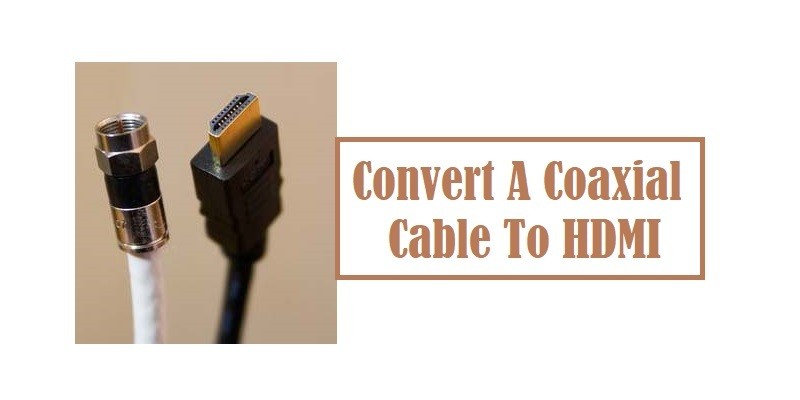
How To Convert A Coaxial Cable To HDMI?
Last Updated on May 5, 2025 by Jim C.
Coaxial cable or “coax cable” was invented to carry radio signals in 1880 by the English mathematician, engineer and physicist Oliver Heaviside. It is composed of two-layer copper wire surrounded by insulation and shielding. The term coaxial came from two conductors (inner and outer) sharing a single geometric axis.
The purpose of making coax cable was to deliver minimally-interfered analog signals. First it was used in radio and telegraphy. Then, TV, broadband and computer technology used it next. These days, people enjoy most of a new technology called fiber which offers the fastest transmission speed so far.
Convert A Coaxial Cable To HDMI
Why do we need to convert coax to HDMI?
Audio and video signals are carried by coaxial cable from a TV programming source to a TV set. High definition TVs are supplied with various jacks so it can be connected to a source. However, some TV packages do not provide one. So it needs to be converted.
HDMI (High Definition Media Interface) is the most common of these digital connections. It uses a 6-sided plug to get the highest video and audio qualities.
Here’s how to convert the coaxial cable to HDMI:
- Attach the cable coupler to the threaded jack on the box. Using your hand, turn it clockwise.
- In the receiver box for cable or satellite TV, connect the other end of the coaxial cable to the compatible.
- An HMDI cable can be inserted in one direction only. The wider end of the cable turned upward must be plugged into the HDMI cable in the adapter box.
- Look for the other end port of the HDMI cable at the back of your TV, a monitor and other video devices. If there is more than one HDMI input on the TV or monitor, check which fits the coaxial cable connection. There is no two cable connection alike in a gadget, machine, or connection, so it will be easy to use. Remember which one works for the coaxial cable connection.
- Plug the adapter and the TV or monitor into a surge protector power strip. Then connect it to the wall outlet.
- Open the TV or monitor.
Now we know that to convert coaxial to HDMI, one needs a powered adapter. This adapter can be attached to both cables within minutes.
Technology evolves so fast. Others say with just the blink of an eye. Fiber may be the most in-demand for communication technology, who knows a few months or years from now, there will be another progression to this speed and signal generation?
DON’T MISS
About the Author Jim C.
Jim C. Clark is the lead tech blogger at TechnoHacks.net, where he delivers insightful content across a wide range of digital topics. With a keen interest in emerging technology and practical tools, Jim writes in-depth articles on AI, Python, software, and the latest apps. He also shares expert advice on freelancing, digital marketing, SEO, and business growth strategies. Known for his clear, engaging writing style, Jim breaks down complex concepts into actionable insights. Whether he's recommending the best free tools 🧰 or explaining “how to” guides, Jim’s goal is to empower readers with the knowledge they need to thrive in the digital world.